

Welcome back to Day 16 of my 31 Days of Kindergarten series!
Kindergarten anchor charts are one of the most powerful tools for building student independence. While it’s tempting to fill every wall with colorful charts and decorations, I’ve learned that the most effective kindergarten anchor charts are the ones students actually use every day.
If you’ve ever walked into a kindergarten classroom at the beginning of the school year, you’ve probably seen walls covered with charts for every subject imaginable. I know I did when I was a new teacher. I spent hours creating beautiful displays, convinced that more charts would lead to more learning.
Over time, however, I discovered something important: students don’t need dozens of anchor charts. They need a few meaningful charts that provide support when they need it most.
The best kindergarten anchor charts aren’t necessarily the cutest or most elaborate. They’re the charts students refer to independently during writing, cleanup, transitions, and daily classroom routines. When students know where to find answers without always asking the teacher, they gain confidence, build responsibility, and become more successful learners.
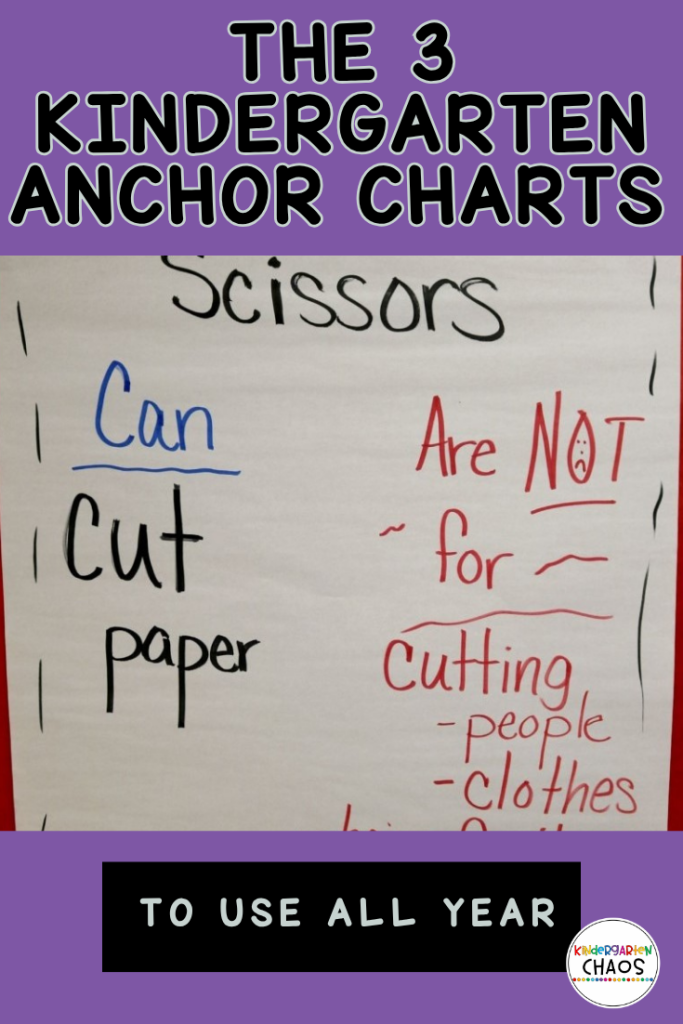
Today, I’m sharing the three anchor charts that will earn a permanent place in your classroom every year.
One of the first lessons to teach each year is how to use classroom supplies correctly. It sounds simple, but kindergarten students need explicit instruction on everything from using crayons to putting away glue sticks.
Without clear expectations, you’ll hear questions all day long:
Instead of answering the same questions repeatedly, teach students to use a classroom supplies anchor chart.
The chart includes visuals and labels that show students:
During the first few weeks of school, you will reference this chart constantly. Before long, students begin solving these problems independently. That’s when the magic happens. When students know how to manage materials on their own, transitions become smoother, cleanup becomes faster, and instructional time increases.


If you’ve followed Kindergarten Chaos for any length of time, you know how strongly I believe in teaching proper letter formation from the beginning. A letter formation anchor chart need to stay on your wall all year long.
Whether your students are learning uppercase letters, lowercase letters, or beginning writing skills, they need a visual reference they can use independently. During writing time, you will see your students walk over to the chart, study a letter, and return to their seat ready to continue writing. Those small moments matter.
Every time a student uses a classroom resource instead of relying on the teacher, they build confidence and independence.
Letter formation charts also support:
Even your strongest writers will continue using the chart throughout the year.

If I had to choose just one anchor chart to keep all year, this might be it. Kindergarten runs on routines. Students thrive when they know exactly what to expect and what is expected of them. That’s why you need to keep a Classroom Systems Anchor Chart visible all year long.
This chart outlines everyday procedures such as:
At the beginning of the year, practice these routines repeatedly. And repeatedly. And then a few more times. The anchor chart serves as a visual reminder students can reference whenever they forget a procedure. One of the biggest mistakes new teachers make is assuming students will remember routines after hearing them once. They won’t. Kindergarten students need consistent visual reminders. Instead of stopping instruction to reteach procedures over and over, simply redirect students back to the chart. Over time, students begin managing classroom routines independently. The result is a classroom that feels calmer, more organized, and more predictable for everyone.
“Anchor Charts For Kindergarten” and “Must-Make Kindergarten Anchor Charts” has more.
Every chart has to earn its space. These three charts do exactly that.
They:
Most importantly, students actually use them. When little learners can locate supplies independently, form letters correctly, and follow classroom procedures without constant reminders, everyone benefits. Learning time increases. Interruptions decrease. Confidence grows.
And that’s exactly what we’re working toward in kindergarten. Sometimes the most effective classroom tools aren’t the newest, cutest, or most elaborate. Sometimes they’re simply the tools students rely on every single day.
These three anchor charts have earned a permanent place in the classroom, and I can’t imagine starting a school year without them.
What anchor chart stays on your wall all year long? I’d love to hear about it in the comments!