
Teaching school supplies is one of those kindergarten routines that can easily get overlooked. We hand a child a pencil, pair of scissors, glue stick, or box of crayons and assume they know what to do. But do they? Probably not! Little learners need us to explicitly teach them how to use classroom supplies before we expect them to use those supplies independently.
Just like we teach letters, numbers, classroom routines, and procedures, we need to teach, model, practice, and reinforce how to use school supplies. And trust me, taking the time to do this at the beginning of the year can save you SO much frustration later!
When teaching school supplies, resist the temptation to put every supply in front of your little learners at once. Instead, introduce one school supply at a time. Start with something simple, such as a pencil.
Hold up the pencil and talk about it with your students.
Ask:
Be very specific. For example, don’t simply say, “Use your pencil correctly.” Tell your little leraners exactly what that means. We use pencils to write and draw on our paper. We don’t use pencils to poke, tap, or play. Your little learners need to know both the correct and incorrect ways to use the tool.
Then move on to your next supply. You don’t have to teach every school supply in one day. Take your time and give your students plenty of opportunities to practice.
I love using anchor charts with little learners because they make our expectations visible. As you introduce each school supply, create an anchor chart with your students. You might include: What is it? What do we use it for? What don’t we use it for?
For example:
We use pencils to:
We don’t use pencils to:
Let your students help you decide what belongs on the chart.
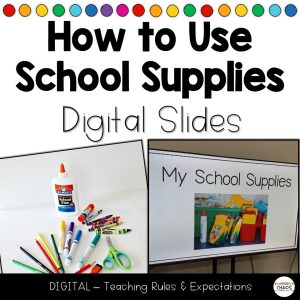
You can also use your How to Use School Supplies Digital Slides during whole-group instruction. The slides make it easy to introduce the supplies visually and discuss the expectations together.


One of my favorite ways to teach little learners is to show them. Don’t just tell them how to use a school supply. Model it! Show students the correct way to use the supply. Then show them an incorrect way. Ask: “Did I use this correctly?”
Little learners LOVE catching their teacher making a mistake! This gives you an opportunity to talk about why something is appropriate or inappropriate. For example, you might hold the scissors incorrectly and ask: “Is this how we carry scissors?” Your students can tell you what you should do instead. This makes the lesson interactive while reinforcing the expectation.
This is the part we sometimes forget. We teach the procedure and then immediately expect students to know how to do it. Instead, give your little learners intentional practice. After teaching scissors, let them practice cutting. After teaching glue, let them practice gluing. After teaching crayons, let them practice coloring. After teaching pencils, let them practice writing or drawing. You’re practicing more than an academic skill.
You’re teaching students how to handle, use, and care for classroom materials.
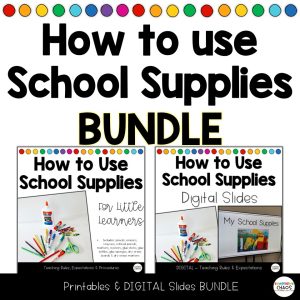
My How to Use School Supplies Printable Resource includes practice pages for common classroom supplies, including pencils, crayons, markers, scissors, glue, and dry-erase materials. Each activity gives students an opportunity to practice the specific supply after you’ve explicitly taught how to use it.
Teach it. Model it. Practice it.
This may be the most important part of teaching school supplies. You can’t consequence a child for using a supply incorrectly if you haven’t explicitly taught the correct way to use it. Think about that for a minute.
If you’ve never taught a child how much glue to use, you can’t be surprised when they squeeze out half the bottle.
If you’ve never taught a child how to carry scissors, you can’t assume they automatically know.
If you’ve never explained that markers are for paper and not tables, clothing, or friends, you can’t expect a five-year-old to know the difference.
Our little learners are still learning. Mistakes are opportunities to teach, model, practice, and reteach. If a child uses a supply incorrectly, stop and reteach the procedure. You might say:
“Let’s remember how we use our scissors. Show me how we carry them.”
Then let the child try again.
That’s teaching.
Taking a few extra minutes to explicitly teach school supplies during the first days and weeks of school can make a HUGE difference in your classroom. Instead of constantly saying: “Don’t do that with the scissors.” “Stop tapping your pencil.” “Put the markers away.” “Why is there glue all over your paper?” You’ll be able to remind students of a procedure you’ve already taught.
“Remember how we use our scissors. Show me.” “Let’s remember our pencil expectations.” “What do we do when we’re finished with our crayons?”
The more we explicitly teach and practice these expectations, the more independent our little learners become.
And isn’t that what we’re working toward?
Don’t assume they know. Teach them. Model it. Practice it. Reteach it. And then give them the opportunity to become independent.
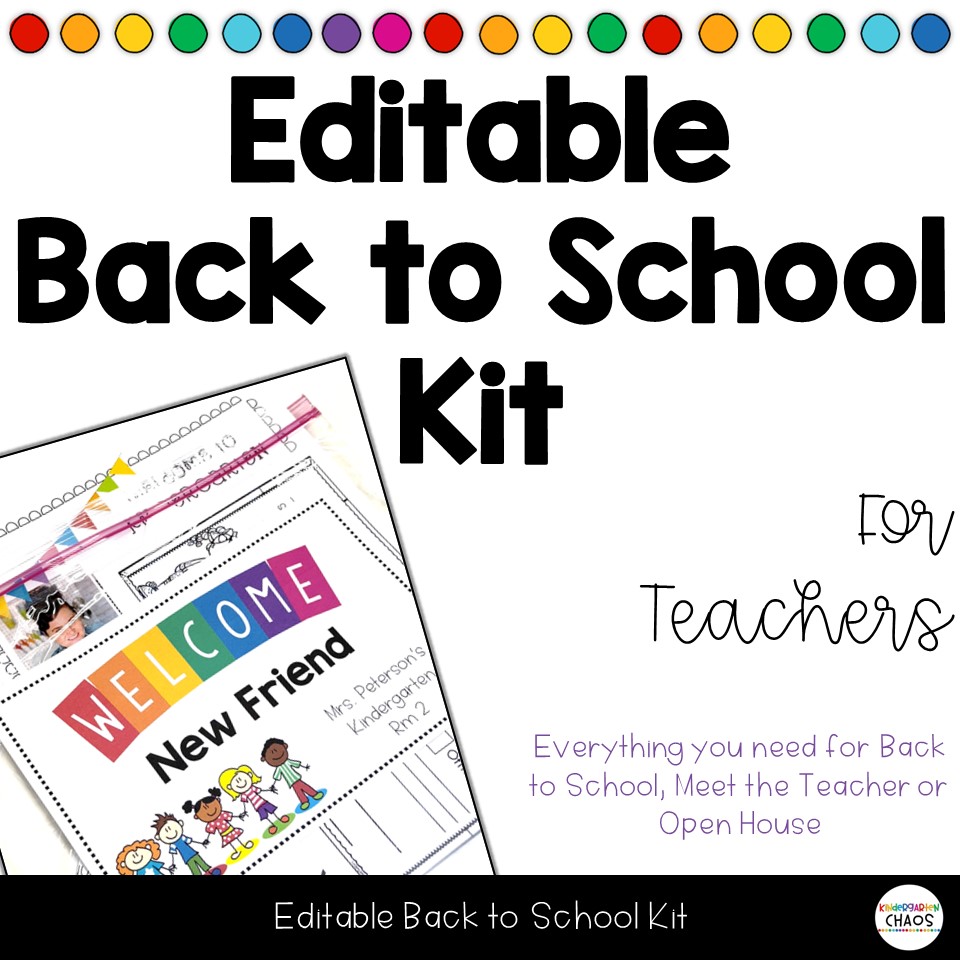
If you are looking for more ideas for starting the school year, check out my Back to School Kindergarten Activities for additional classroom routines, procedures, and intentional activities.
Because when it comes to little learners, we can’t assume they know. We have to intentionally teach them.
Those little lessons in the beginning of the year can make a BIG difference in how smoothly your kindergarten classroom runs all year long.